 Detune
What Is Detune?
Detune means shifting one sound a few cents off another so the two beat against each other. How much is too much, and where you have heard it before.
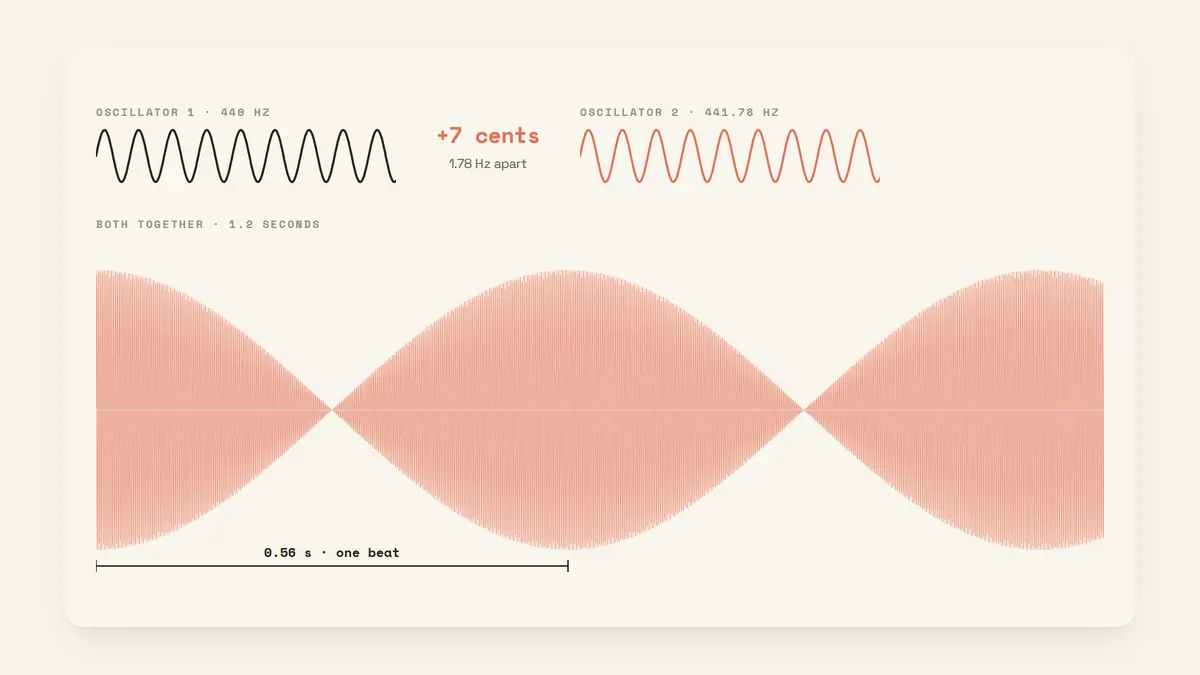
Detuning means shifting one sound slightly off the pitch of another, usually by a few cents, so the two beat against each other. That beating is what your ear reads as thickness and width. By the end of this page you will know what the control does, why it works, how far you can push it, and how to spot it in a record.
What does detune mean in music?
In music, to detune is to move a pitch away from where it should be. On a synthesizer that means one oscillator is tuned a few cents above or below another, on purpose. On a guitar it means the whole instrument is tuned lower than standard. The word covers both, and they sound nothing alike.
The synth sense is the one most people are searching for. Almost every synth has a control labelled Detune, Fine or Fine Tune on its second oscillator. Turn it up and the sound gets wider and thicker. Turn it up further and it goes sour. The reason for both is the same physics.
Why two detuned oscillators sound thicker than one
Two oscillators a few cents apart drift in and out of phase, and the volume swells and dips at a steady rate. Your ear hears that swell as movement and width rather than as two separate notes.
Here is the mechanism with numbers. A sawtooth at A4 is 440 Hz. Detune a second one by 7 cents and it lands at 441.78 Hz. The two waves line up, then slide apart, then line up again, 1.78 times a second. That 1.78 Hz wobble in volume is called beating, and it is the whole effect. A single oscillator is a still photograph. Two detuned ones are a slow shimmer.
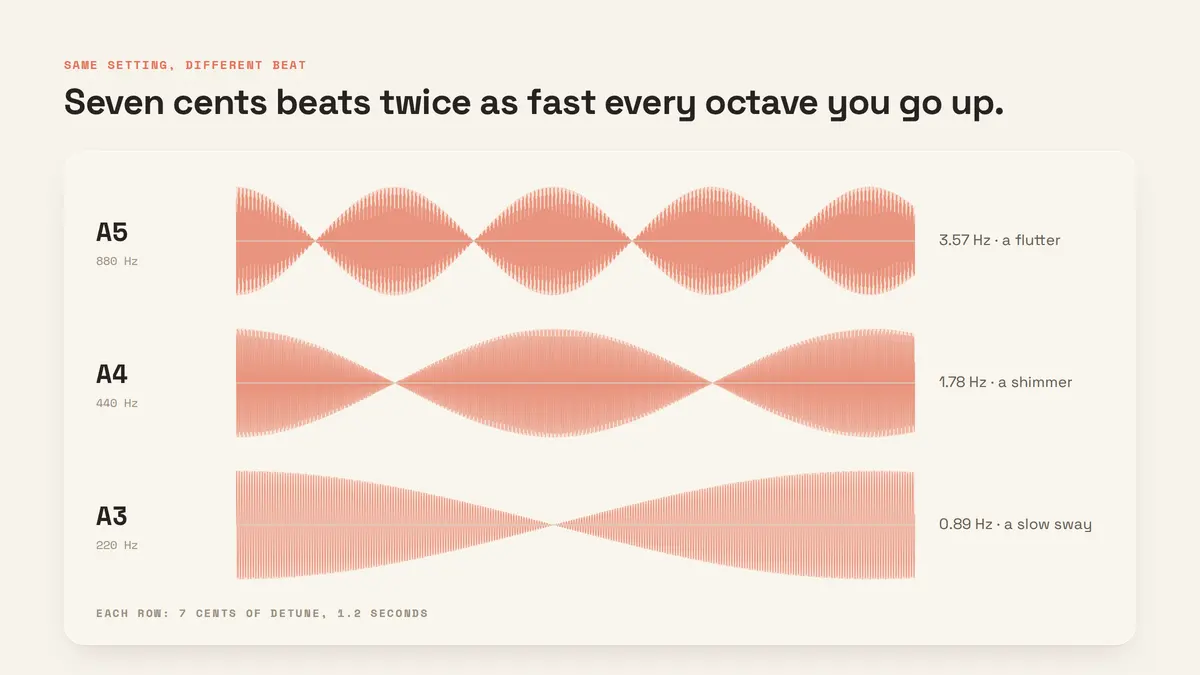
The beat rate follows the difference in hertz, not the difference in cents, so the same detune setting behaves differently across the keyboard. At A3 (220 Hz) those 7 cents beat at 0.89 Hz, a slow, wide sway. At A5 (880 Hz) they beat at 3.57 Hz, a faster flutter. Play a detuned patch low and it feels huge. Play it high and it starts to sound like vibrato. That is why bass patches and lead patches want different amounts.
Stack more oscillators and the beating stops being a single rate and becomes a smear. Roland’s JP-8000 did exactly this in 1997 with a waveform called Super Saw: seven sawtooth waves detuned against each other, mixed as one. It became the sound of trance and never left. A supersaw is nothing more than detune, multiplied.
How much detune is too much?
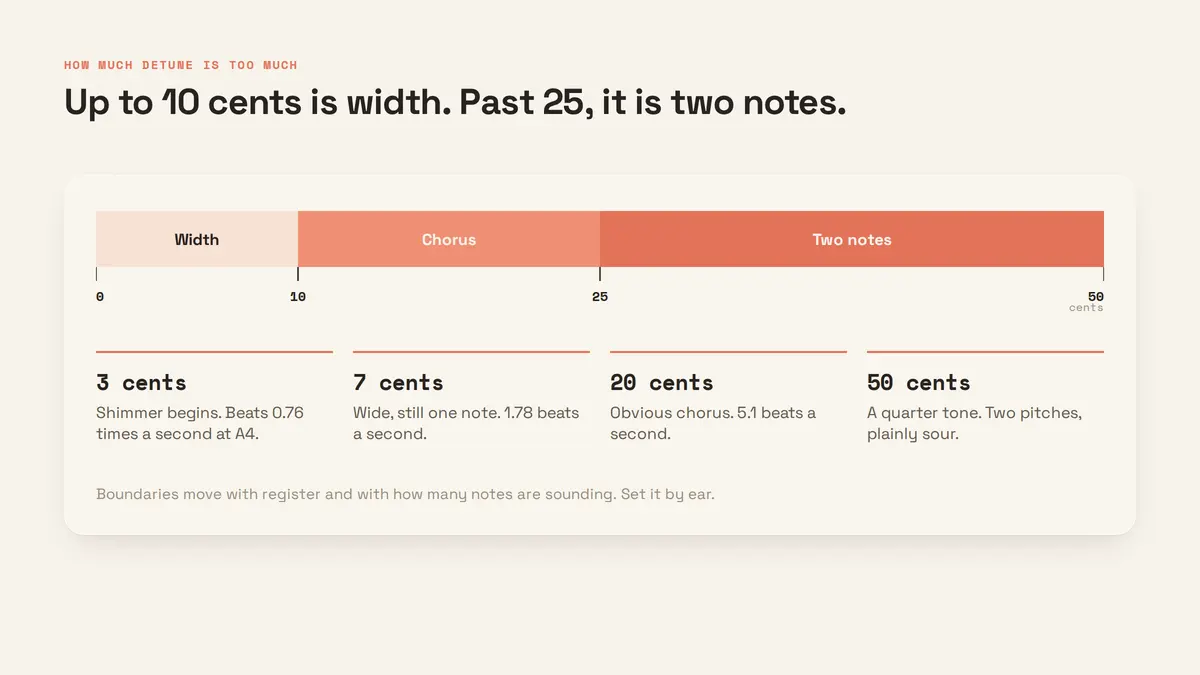
Up to about 10 cents reads as width. Between roughly 10 and 25 it reads as chorus. Past 25 or 30 cents most listeners hear two notes slightly out of tune with each other rather than one wide note, and by 50 cents (a quarter tone) it is plainly sour.
Those boundaries move with what you are playing. Chords stack the beating of every note, so a detuned pad wants less than a detuned monophonic lead. High notes beat faster, so a lead patch that sits at 12 cents in the bass register may need 6 up the octave. And a slow, sustained sound tolerates more than a fast pluck, because a pluck is over before the beat has time to swell.
Set it by ear. Hold one note, start at zero, and turn the detune up until you hear the shimmer begin. Keep going until you can hear two pitches, then back off. The right value is somewhere between those two points, and it will not be the same for the next patch.
Detune on guitars, and why it is a different thing
A detuned guitar is tuned lower than standard, usually by whole semitones: half a step down to E flat, or the low string dropped to D. The aim is a lower register, heavier strings and a looser feel under the fingers, not shimmer.
The two senses share a word and nothing else. Synth detune is measured in cents and is about the relationship between two sounds. Guitar detuning is measured in semitones and is about where the instrument sits. If a guitarist and a synth player both say a track is detuned they are describing different things, and both are right.
There is a middle case. A 12-string guitar pairs each of its lower strings with one an octave up, and the pairs are never perfectly in tune. The result is the jangle you know from the Byrds. A honky-tonk piano gets its sound the same way: the two or three strings behind each key are deliberately left slightly apart. Both are synth detune done in wood and wire.
The other meanings: radio circuits, engines and ski edges
Outside music the word keeps the sense of moving away from a tuned point. A radio receiver is detuned when it is set slightly off a station’s frequency. An engine is detuned when a manufacturer deliberately limits its output, often so a racing engine survives on the road. Skiers detune the tips and tails of their edges, dulling them so the ski does not catch when it turns.
If you arrived here from one of those, the music sense is the odd one out: it is the only field where detuning is done to make something sound better.
What does Detune do in Auto-Tune?
In Auto-Tune, Detune shifts the pitch reference the plugin corrects to. Antares’ own documentation says the control changes the reference from the default A = 440 Hz, with a range of -100 to +100 cents.
You would use it when a recording was tracked to an instrument that was not at concert pitch: a piano that has drifted, or a band tuned down. Set Detune to match and the plugin corrects to the track’s tuning rather than fighting it. It has nothing to do with the synth effect above. Same word, third meaning.
What does it mean for a beat to be detuned?
A detuned beat is one whose tuned elements, usually the 808 or a sampled melody, sit off standard pitch. Sometimes that is deliberate: producers pitch a sample by a few cents so it feels older or slightly wrong. More often it is an accident. The sample was never at concert pitch, and anything tuned to A = 440 played over it will clash.
The fix is the same either way. Find the root note of the beat with a tuner, and tune your bass and melody to that rather than to the piano in your head.
How to hear detune in records you already know
Listen for a sound that swells and shimmers while the note stays still. A trance lead that seems wider than the speakers is stacked detuned saws. The soft wobble on a Juno pad is its chorus, and chorus is detune applied by delay rather than by a second oscillator. The Byrds’ 12-string, a saloon piano and the pad under most synthwave tracks are all the same mechanism at different speeds. If that pad is also pulsing in sixteenths, an arpeggiator is running on top of the detune.
Once you can hear the beat rate you can hear the setting. Slow and wide is a few cents. Fast and rough is many. Two notes fighting is too many, unless that was the point.
Detune is one of the first things you reach for on a synth and one of the last you master. The number is easy. Hearing when the number is right takes practice, and the only way to get it is to turn the control with the note playing.